
Sunrise of The Great Ridge at Mam Tor hill in Peak District, taken by Pajor Pawel, 2018, via Shutterstock
A place to begin again: How community spaces in Sheffield are rebuilding trust across difference
In a city shaped by migration and austerity, grassroots organisations are doing the quiet, unglamorous work of building sanctuary, one conversation at a time.

On a damp Friday afternoon in Sheffield, the transformation of the main hall at the Central United Reformed Church begins with the rhythmic click of a kettle. There is no gavel, no formal agenda, and no facilitator calling the room to order. Instead, the space fills with the low hum of people shaking off the South Yorkshire chill and the melodic clink of teaspoons against ceramic. Names are signed into a register with a practiced ease, drinks are collected, and conversations begin in small, organic pockets across the floor.
There is no formal start to these proceedings. No one stands on a chair to demand silence. Instead, the afternoon unfolds quietly, its shape determined entirely by whoever happens to be there. At one table, a group leans in, navigating the gaps in a shared language with expansive gestures and a great deal of patience. Across the room, someone joins an activity table to focus on a craft, while another sits back, nursing a mug and simply watching. For newcomers, there is no pressure to perform “integration” or prove their worthiness. They can watch, settle in, and find their place at their own pace.
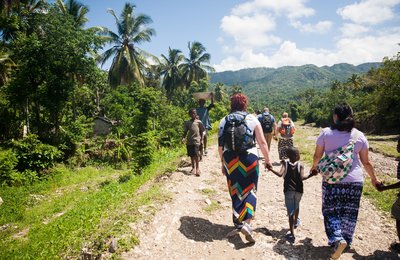
This is a typical session at Conversation Club, a Sheffield-based initiative that brings together refugees, asylum seekers, and long-term residents in a shared social space. Beyond conversation, the club offers informal English classes, organised walks into the Peak District, and cultural trips, a programme designed to ease newcomers gently into the life of the city. In a city defined by both its history of migration and the harsh edges of modern austerity, this space is doing the radical, unglamorous work of peacebuilding. It is informal by design, operating on the belief that trust is not something that can be mandated from a government office, but something that must be grown, person to person, over a hot drink.
“Some have described the club as being like a family, a community of nations.” — Jim Dimond, volunteer and trustee
A city of sanctuary under pressure
Sheffield holds a storied place in the landscape of British social justice. In 2007, it became the UK’s first City of Sanctuary, a title that signalled a commitment to moving beyond mere tolerance toward a proactive culture of welcome. This wasn’t just a symbolic gesture; it sparked a network of grassroots organisations dedicated to making the city a home for those fleeing violence, climate catastrophe, and persecution. City of Sanctuary Sheffield (COSS) works to bridge the gap between long-term residents and newcomers through community-based initiatives and collaborative projects.
However, that vision of “sanctuary” currently exists alongside much more difficult realities. Years of austerity have hollowed out the local social fabric, placing immense pressure on services that were once robust. Access to stable housing, welfare support, and specialised legal aid has become increasingly difficult, shaped by funding cuts, bureaucracy, and overstretched services. For a person arriving in the city, the challenges are immediate and overlapping: language barriers, financial insecurity, and the suffocating uncertainty of the UK’s asylum system.
When people are pushed to the margins by policy, communities risk becoming “parallel societies,” existing in the same postcodes but never truly meeting. The “Hostile Environment” policy, designed to make life difficult for those without status, often has the side effect of chilling social cohesion for everyone. It is within this friction, between a city’s desire to welcome and a state’s mechanism of exclusion, that local peacebuilding must take shape. Peace, in this context, is not the absence of conflict, but the presence of connection.
Listening as practice, not principle
If local peacebuilding is to be effective, it must avoid the trap of “top-down” charity, where the marginalised are treated as passive recipients of aid. City of Sanctuary Sheffield has sought to challenge this dynamic through its Know Me project, a long-term, co-produced research process designed to better understand the lived experiences of those who shape the organisation’s work.
In a world where “consultation” often feels like a box-ticking exercise, the Know Me project represents a deeper commitment to organisational humility. It involved more than 60 participants and was carried out through in-depth interviews, focus groups, and ongoing reflective sessions. Crucially, the project was led in part by the Experts by Experience (EbE) team, individuals who have moved through the asylum system themselves and now occupy central roles in designing and conducting research.
The findings, which inform the organisation’s strategic direction, highlight a profound contrast. Participants consistently described the space as an “oasis,” a rare zone of safety and dignity in a system that often feels designed to strip those qualities away. Yet, the research also surfaced the growing strain on staff and volunteers as demand increases and the legal landscape becomes more complex. By embedding lived experience into leadership, COSS demonstrates that peacebuilding requires a constant, honest feedback loop. It is a model where listening is not a one-off activity but an ongoing practice that shapes policy and service delivery alike.
Informal spaces, everyday trust
While COSS provides the structured advocacy and support, Conversation Club operates at the level of everyday human chemistry. Its sessions are deceptively simple: people arrive, find a place to sit, and begin talking. Yet, that simplicity is the result of careful, intentional boundaries.
“There is a supportive, non-judgemental atmosphere where everyone’s contribution is valued,” Jim says. Volunteers are meticulously careful not to ask intrusive questions about personal histories or pending asylum cases. Privacy is a form of respect here. In a system where refugees are constantly asked to perform their trauma for officials, a space where no one asks “Why are you here?” can offer a rare sense of ease and dignity.
For many, the first challenge is simply crossing the threshold. Participants often arrive facing the “quiet violence” of the asylum system: the isolation of living in temporary accommodation, the inability to work, and the emotional toll of being separated from family.
Over time, the architecture of the space itself begins to foster trust. The act of showing up week after week, sharing biscuits, joining informal English classes, or heading out on organised walks to the Peak District, gradually transforms the room from a gathering of strangers into a site of mutual recognition. This is what peacebuilders call “contact theory” in action, but without the academic jargon. It is the realisation that it is much harder to fear or “other” someone once you have helped them find the right word for “kettle” in English.
Small shifts, lasting change
The impact of these interactions is rarely dramatic or immediate. Instead, the change is visible in the “small shifts.”
“It is brilliant to see people growing in confidence and communicating well in English,” Jim says, describing the trajectory of regular attendees. These transformations extend beyond mere linguistics. Mohammed, a club member from Afghanistan, described Conversation Club as “a good place for overseas people to make friends.” He added that the club helped him “build my confidence and not only improve my spoken English, but my written English, and make a lot of English and non-English friends.”
You see these changes in quieter ways too: when a former participant, who once sat in the corner in silence, returns as a volunteer interpreter to help someone else navigate their first day. Or when friendships form across the cultural and linguistic divides that so often keep people apart in the city.
Some participants move on to employment, education, or training, while others become trustees of the very organisations that once supported them. These are the markers of success in local peacebuilding: when a “service user” becomes a “space maker.” It illustrates a broader principle shared across Sheffield’s community initiatives: people seeking sanctuary are not problems to be solved, but active participants in shaping the future of the city.
The limits and possibilities of the local
It is important not to romanticise these efforts. There are hard limits to what local organisations can achieve. They cannot fix a broken national housing market, they cannot overturn restrictive immigration laws, and they cannot conjure funding out of thin air. Peacebuilding at the grassroots level can feel like trying to hold back a tide with a tea towel when structural forces are working against you.
Yet, to dismiss these efforts as “merely social” is to misunderstand how social change happens. These spaces provide the psychological and social “ballast” that allows people to survive the uncertainty of the system. They show that peacebuilding does not always require high-level intervention; it can happen through repeated, respectful human interaction. When a city refuses to let its newcomers remain invisible, it creates a more resilient community for everyone.
Looking forward
The successes of the Know Me project and Conversation Club offer a blueprint for other urban centres grappling with division. Genuine community engagement depends on three things: listening, participation, and consistency. Spaces designed collaboratively can offer more than support. They can create a genuine sense of belonging.
In Sheffield, division does not always look like a riot or an open conflict. More often, it manifests as distance, silence, or “parallel lives.” Bridging that distance requires more than policy; it requires physical spaces where people can meet, talk, and be seen as more than their legal status.
At the end of a Friday afternoon, the main hall slowly empties as the last of the tea is poured away. People head back out into the Sheffield air, carrying with them a little more confidence, perhaps a few new words, and the memory of a conversation that mattered. In a world where trust is increasingly fragile, this slow, quiet process of rebuilding is exactly where we have to begin. One conversation at a time, Sheffield is proving that sanctuary is not a place you find, it is something you build together.
Israel Temmie
Israel Temmie is a freelance writer and journalist focused on social issues, grassroots movements, and human stories from around the world. His work explores the intersection of community-led initiatives, culture, and social change, highlighting underreported voices and locally-driven solutions.
Read more from Israel Temmie