What happens next in Nepal?
Fear and uncertainty over Nepal’s future as the authority of the Constituent Assembly expires without producing a new constitution

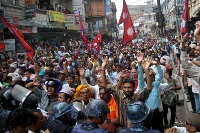
Fear and uncertainty over Nepal’s future as the authority of the Constituent Assembly expires without producing a new constitution

Civil society in Nepal is active in challenging impunity and demanding for justice for conflict victims.

I did not feel safe when I travelled to Bardiya in the last week of November, 2010. Just before my journey, the district treasurer of the Nepali Congress was killed by unidentified persons on the east-west highway near the Bardiya National Park, while he was returning to his home around 6pm. I landed at nearby Nepalganj airport around 6.30pm, and then had to drive one-and-a-half hours to the district headquarters of Bardiya, at Guleriya. Just a couple of days before, two children aged 13-14 had been kidnapped for ransom near Nepalganj, and killed after the kidnappers received the ransom money. My unsafe feeling increased when I drove through the village where the kidnappers lived, as my driver suddenly told me this. Thank God! I arrived safely at the hotel where my accommodation was booked for the next four days.
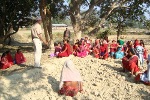
In SindhuliI district, Nepal, how far have people rebuilt their lives and communities since the end of the conflict?
Nepal’s seven month-long prime ministerial election finally ended last week, Ambika posts an update on the political situation in the country.
Ambika reports from Nepal on the annual Disdain festival, and the country’s struggle to elect a Prime Minister to move the peace process forwards.
Unfortunately the seventh round of elections for the position of Prime Minister of Nepal has once more failed to produce a result. (See my previous posts for coverage of earlier rounds in this process). One change however is that the the candidate of Unified Communist Party of Nepal-Maoist (UCPN-M), Mr. Puspa Kamal Dahal, has declared his withdrawal from the race to be PM. Mr. Dahal has made this decision following the three-point agreement with the Chairperson of the Communist Party of Nepal-Unified Marxist and Leninist (CPN-UML). The both parties have also asked the Nepali Congress (NC) to withdraw its candidacy of the PM post too. They have claimed that for the national consensus government, both parties have to withdraw their candidates for the PM post. The three-point agreement focused on a way to break the deadlock in the PM election process and the formation of the national consensus government.
Ambika Pohkrel asks if there is any end in sight for the process of selecting a new Prime Minister for Nepal – now set for the fifth round of voting in the Constitutional Assembly.
‘Resignation of the Prime Minister’ – the much awaited demand of the Unified Communist Party of Nepal-Maoist (UCPN-Maoist) was finally fulfilled on June 30
It is very hard to wait for news when you know that something really meaningful and important is about to happen; we in Nepal experienced this last Friday – the last day of the two-year term for the Constituent Assembly
The political dynamic is changing everyday in Nepal. It is difficult to predict the likely scenario of politics considering the day to day politics.
The ‘indefinite general strike’ called by the Unified Communist Party of Nepal-Maoist (UCPN-M) recently ended, after 6 days