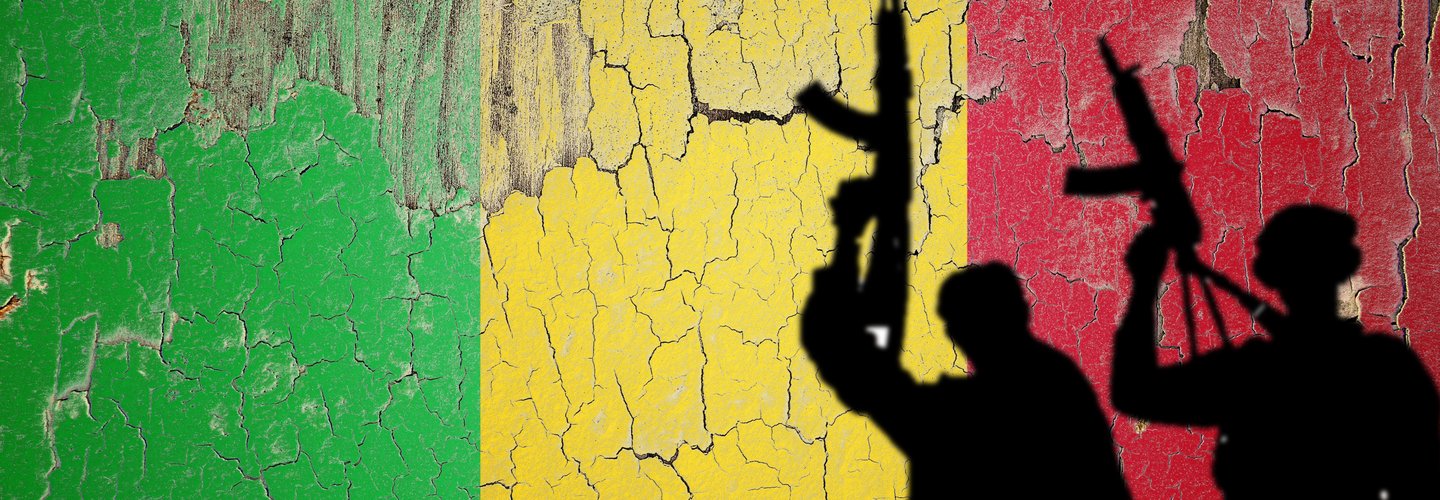
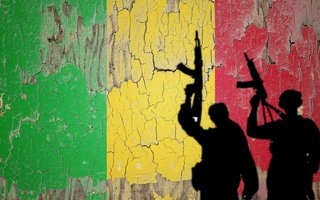
Flag of Mali painted on the cracked wall with terrorist shadow. Taken by ZMotions, April 2024, Via Shutterstock
Mali: Blockade around Bamako eases after several months of fuel crisis
Since October 2025, Mali has been experiencing a fuel crisis caused by a blockade aimed at disrupting fuel supplies to Bamako, the country’s capital. While the situation is slowly returning to what it was before the blockade, this period marked a decisive turning point in the balance of power within the country.
Since October 2025, Mali has been experiencing a fuel crisis caused by a blockade aimed at disrupting fuel supplies to Bamako, the country’s capital. The blockade was imposed by jihadists from the Jama'at Nusrat al-Islam wal-Muslimin (JNIM) group, a terrorist movement affiliated with Al-Qaeda. While the situation is slowly returning to what it was before the blockade, this period marked a decisive turning point in the balance of power within the country, which we will examine more closely in this article.
JNIM imposed the blockade following a decision by the transitional authorities to ban the sale of fuel in cans in several localities,[1] a major source of supply for rural communities but also for jihadist groups. JNIM is controlling the roads connecting Bamako to its surroundings. Convoys carrying fuel to the city have faced armed attacks despite attempts to provide military escorts. Civilians have also been intimidated, harassed and forced to wear veils on buses travelling on these roads.
Through these acts, “the JNIM seeks to present itself as a ‘protector’ of the local population and attempts to establish its influence among other armed actors such as the Islamic State in the Sahel (EIS) and the national armed forces, which have so far been supported by their Russian auxiliaries such as the Wagner Group, now known as Africa Corps,” a security governance expert said.
The authorities are attempting to defuse the situation by strengthening their trade links and relations with neighbouring countries to prevent the fuel shortage from leading to a scarcity of food and other basic necessities.
According to some sources,[2] the authorities have also attempted to negotiate a truce with JNIM to put an end to the attacks on fuel trucks, but JNIM has made it a condition that the government publicly announce its intention to engage in dialogue with JNIM. These negotiations appear to have gone awry, as clashes continue between the Malian Armed Forces (FAMa) and jihadists in the south, centre and north of the country.
Meanwhile, JNIM has also strengthened its financial and political position. According to several sources, including the African Security Sector Network (ASSN),[3] JNIM received US$50 million in ransom for the release of Middle Eastern hostages, including an Emirati national last November. There are some rumours that have mentioned the release of JNIM jihadist detainees by the Malian authorities. However, the authorities remain silent on the subject.
In the areas it controls, JNIM imposes vehicle tolls and exploits the religious obligation of zakat to levy taxes in the territories under its control. This is in addition to controlling and taxing artisanal gold mining and cattle theft. These levies are often imposed by force rather than voluntarily. In exchange, JNIM promises relative protection for local populations against other armed groups or abuses by the authorities.
What about peacebuilders?
Peacebuilders continue to operate despite the difficult context and multiple additional challenges – the suspension of funding from partners, growing insecurity on the roads, cases of kidnapping by jihadist groups, fuel shortages and rising food prices. However, their situation varies from one moment to the next, from one context to another and from one locality to another. While some continue their work at risk, others are completely unable to carry out their activities.
In the south of the country, for example in Djalakorobougou (a town in the Kuba district of the Koulikoro region), peacebuilders are managing to work despite delays in the implementation of several projects, according to a local witness.
However, in certain areas of insecurity such as Damba Diawara, in the Kayes region, or Banamba (a district in the Koulikoro region), local actors, particularly women, face challenges in travelling for security reasons, according to a project manager working in the area. Travel by private car is rare and people use public transport in strict compliance with the instructions of the jihadists. This is also the case in the northern regions, where local peacebuilders carry out their activities under the same conditions of resilience. Travel is possible without major difficulties in peri-urban areas by adapting to the conditions imposed by armed groups, such as wearing the hijab (Islamic veil) and not reporting jihadists to the Malian armed forces.
Furthermore, some actors in the Kita region, such as in Kella and Neguella, for example, express their relief at the improvement in security following the construction of a security post by the authorities. Several civil society organisation (CSO) members from these regions recently participated in activities in Bamako. Some took time to travel due to restrictions on movement at certain times of the night in certain regions.
Awareness-raising, education and information activities on peace can be carried out, but without singling out any particular group or community.
“Despite the security challenges, we are managing to adapt. For us, the biggest challenge remains the scarcity of funding, which is affecting our ability to work,” said a female leader working in the north of the country.
A tense socio-political and security climate
These dynamics are part of a tense socio-political and security context in Mali – including the dissolution of political parties, political and opinion leaders in prison or exile, extension of the transition period, increase in terrorist attacks, and more – that calls into question the legitimacy of the Malian transitional authorities.
This instability is further exacerbated by Mali’s break with certain international partners between 2022 and 2024, such as MINUSMA,[4] ECOWAS,[5] France, the Takuba force,[6] EUTM,[7] and the expulsion of certain economic operators, entrepreneurs and investors from the private sector.
A national charter for peace and national reconciliation was adopted in May 2025. This charter is presented as a reference document[8] that updates and summarises all the national instruments that characterise life in Malian society. It is similar to a code of conduct for authorities and citizens. However, it must be acknowledged that a significant section of society, which is key to peace and stability, did not take part in the dialogue – including the armed rebel groups of the CMA,[9] the current FLA,[10] the leaders of dissolved political parties and civil society leaders opposed to the transition.
The persistence of serious human rights violations
In a statement released on 18 November, Human Rights Watch (HRW) accused the Malian army and Dozo militias[11] of “massacring” 31 civilians. HRW claimed that the massacres took place on Thursday 2 and Monday 13 October in the Ségou region in central Mali.[12] The inhabitants of certain localities were also forced to leave their towns and villages due to fighting between jihadists and armed forces, as was the case in the towns of Loulouni and Léré.
As for the authorities, they have opted for silence: everything is proceeding as if the situation were normal. This stance by the state has provoked a variety of reactions. For some, it shows the state is unable to ensure the safety of the population and the public space is so tightly controlled that citizens’ voices have virtually disappeared. For others, the silence seems intended to deny legitimacy to the jihadists.
Only time will tell how far this crisis could go.
Resources
[1] The official gazette L’Essor, Koro/Bandiagara: Restrictions on the flow of fuel tankers from 20 March 2025. Link: https://www.maliweb.net/koro-bandiagara-restrictions-sur-le-flux-des-camions-citernes-de-carburant.
[2] RFI, Mali: What is the status of negotiations with jihadists to lift the blockade? Link: https://www.rfi.fr/fr/afrique/20251009-mali-où-en-sont-les-négociations-avec-les-jihadistes-pour-la-levée-du-blocus.
[4] United Nations Multidimensional Integrated Stabilisation Mission in Mali.
[5] Economic Community of West African States.
[6] Task Force Takuba is a European operational force deployed in Mali as part of the fight against armed terrorist groups. It was disbanded in 2022.
[7] European Union Training Mission, https://eutmmali.eu/fr/.
[9] Coordination of Azawad Movements.
[10] Azawad Liberation Front.
[11] The Dozos are traditional hunters close to the state who fight jihadist armed groups in the centre of the country.
[12] According to Africa radio.com, link: https://www.africaradio.com/actualite-112098-mali-human-rights-watch-accuse-31-civils-tues-au-mali-dans-des-massacres-attribues-a-l-armee-et-aux-milices.
For security reasons, we cannot publish the name of the author of this post.
Read more from Anonymous