Kirghizistan : bâtisseurs de la paix et l’ONG anti-Bill
Inga Sikorskaya explique comment la société civile kirghize mobilisés pour bloquer une loi controversée anti-ONG.
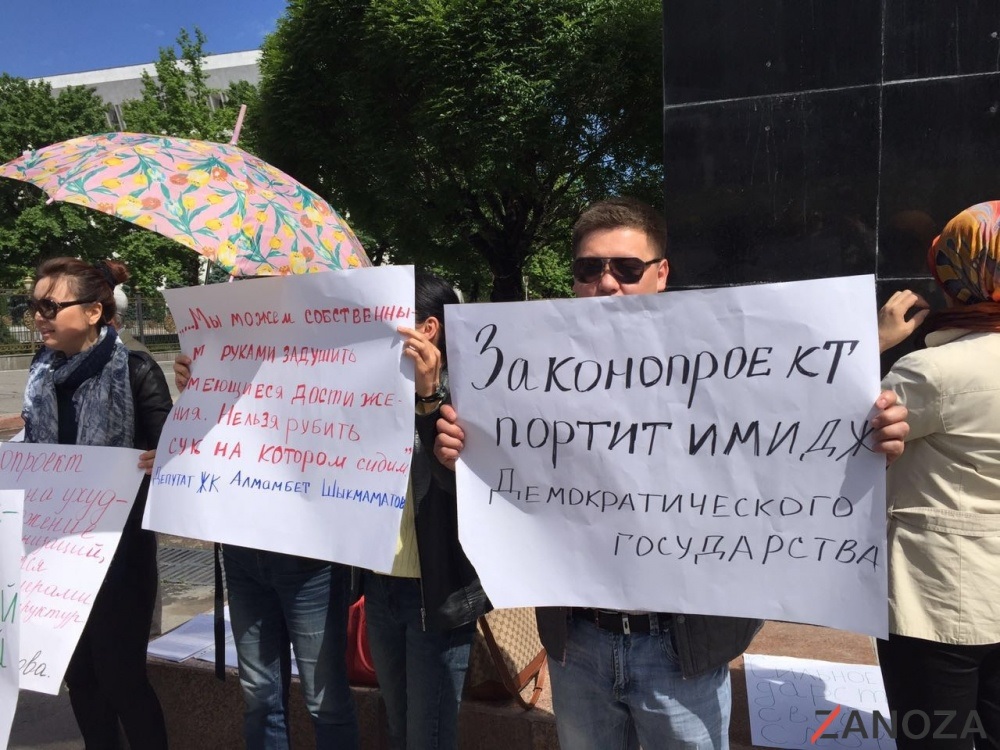
Civiles activistes lors d’une manifestation contre la Loi de l’agent étranger. Crédit image : Inga Sikorskaya /
Kirghizistan, comme la seule démocratie en Asie centrale, a une société civile forte
en 2012, l’adoption d’une loi russe, se référant aux ONG financées de l’étranger comme « des agents étrangers » a été proposée par le parti politique kirghize Ar Namys (« dignité »), qui se trouve à proximité de Moscou. Bien que le parti n’a pas gagné des sièges lors des élections de 2015, son initiative législative est restée à l’ordre du jour. Débats sur la nécessité d’amendements à la loi intensifié en 2014 au milieu de l’adhésion du Kirghizstan à l’Union économique eurasienne, supervisé par le Kremlin.
Selon le projet de loi, des organisations non gouvernementales au Kirghizstan devaient être appelés « agents étrangers » s’ils ont reçu des fonds provenant de sources étrangères ou internationales et ont été impliqués dans des « activités politiques ». Législateurs interprété cette dernière expression comme une activité visant à influer sur la politique du gouvernement ou l’opinion publique.
Ceux qui ont soutenu limitant l’activité des ONG a accusé le secteur civil de « déstabiliser le pays et l’organisation de manifestations ». En outre, le projet de loi intitulé l’état de suspendre l’activité d’un « agent étranger » pour six mois, si l’entité n’a pas appliqué à l’inscription en tant qu’ONG fonctionnant comme un agent étranger.
Depuis deux ans, les amendements proposés face à la forte opposition par le secteur non gouvernemental au Kirghizistan, y compris non seulement les associations civiles, mais aussi les syndicats et les partis politiques.
De nombreux militants de la consolidation de la paix étaient préoccupés par l’impact négatif sur leurs activités ; presque tous les projets mettant l’accent sur la prévention des conflits dans le sud du Kirghizstan après les violences ethniques de 2010, la non-discrimination et la protection des minorités, sont financés par des donateurs étrangers. Si le projet de loi avait été adoptée, leur mise en œuvre pourrait être suspendue, qui aurait un impact sur la stabilité et les interrelations qui existent dans la société. Défenseurs des droits de l’homme craint également le projet de loi qui ressemble à la pratique russe limiterait l’activité des ONG, spécifiquement liée au travail sur les questions de gouvernance, de transparence et de droits de l’homme.
En mai 2015, un groupe composé d’organisations de droits de l’homme 28 d’Europe, les USA et des anciens États soviétiques a appelé les législateurs kirghize à rejeter le projet de loi tel qu’il pose une « grave menace » pour la société civile au Kirghizstan.
Consolidation de la paix aux yeux du public : le rôle des organisations locales
Des militants ont exigé le retrait d’un projet de loi qui a identifié les ONG comme « agents étrangers »
Kirghizistan, comme la seule démocratie en Asie centrale, a une société civile forte, avec plus 15 000 ONG enregistrées qui représentent 2,2 % du PIB national. C’est la même que celle des services de transport de fret ou de production d’aliments et de boissons.
Groupes de la société civile, dirigés par des organisations de consolidation de la paix, qui s’est tenue une campagne au Parlement pour convaincre les législateurs que la nouvelle loi porterait atteinte à la mise en œuvre des programmes sociaux nécessaires. Ces organisations travaillent sur un gros paquet de l’éducation, la santé et au Kirghizistan que l’État n’a pas à financer des projets de sensibilisation. Les militants ont exigé le retrait du projet de loi qui jugé ONG « agents étrangers » puisqu’il a couru à l’encontre des normes démocratiques et le droit constitutionnel des citoyens à la liberté d’association.
Chaque mois l’équipe du Centre International « Interbilim » et le human rights movement Bir Duino Kirghizistan a recueilli des signatures contre la loi discriminatoire et soumis à demandent à ces pétitions au Président et au Parlement, tout en préparant lance un appel aux législateurs et l’Ombudsman pour la protection des ONG contre la discrimination. Plus de deux ans, ils ont organisé plus de 10 actions de protestation et une campagne de sensibilisation majeure dans les médias et les réseaux sociaux sur le rôle des ONG dans la vie sociale du pays.
En février 2016, Bir Duino militants ont annoncé qu’ils allaient entamer une action en justice contre les auteurs, trois législateurs dans le Parlement précédent. Défenseurs des droits de l’homme a dit qu’ils étaient prêts à contester la loi inconstitutionnelle au cours des audiences publiques avec la participation des députés, où les représentants des ONG sont arrivés avec un slogan « nous ne sommes pas des agents de l’étranger, nous sommes patriotes ! » En mai 2016, Bir Duino a tenu un forum spécial à Bichkek pour soutenir les associations, avec la participation de représentants des organisations non gouvernementales, pour discuter de leurs prochaines étapes afin de bloquer le projet de loi.
Ces mesures actives prises par la société civile fortement affecté les opinions des parlementaires. L’an dernier, législateurs modifié le projet de loi, a étudié des solutions de rechange et en conséquence, supprimé le membre de phrase « agent étranger ». Sans cette phrase l’initiative a perdu son point et la majorité des législateurs contre les amendements.
L’expérience des groupes civils du Kirghizstan dans la sensibilisation du public et de plaidoyer montre l’importance et la puissance d’une société civile active pour d’autres pays, mettant l’accent sur son rôle dans la résolution de problèmes au niveau plus élevé. Il est regrettable que ni la Russie ni les Etats voisins d’Asie centrale semblent capables de parvenir à un changement positif par le biais de telles campagnes.
Locations
Themes